
Tracing Payout Structures from 18th-Century European Salons to Modern Algorithmic Card Simulations
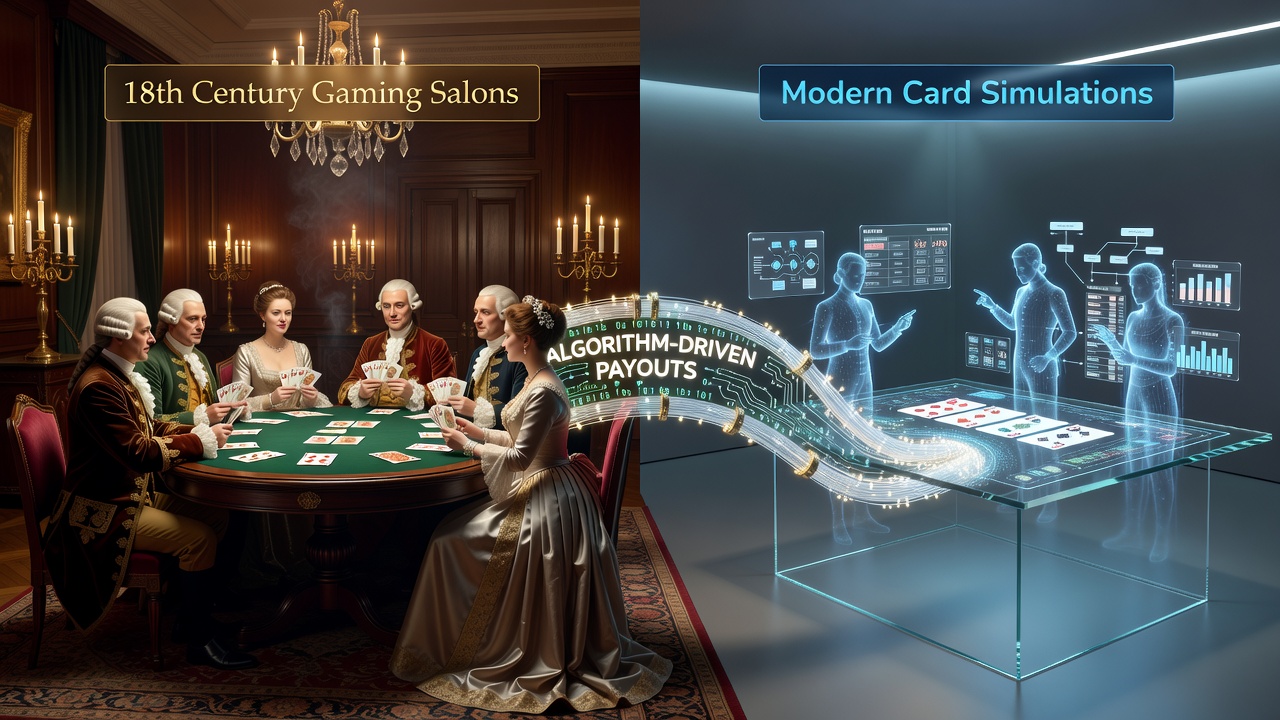
European gaming salons of the 1700s operated as central hubs for card play among nobility and merchants, where rules for games such as faro, piquet, and basset determined payouts through established customs rather than automated systems. Those venues maintained house advantages through fixed ratios printed on table layouts or announced by croupiers, and records from Parisian and London establishments show consistent payout structures that favored operators by margins between 1 and 5 percent depending on the game variant. Historians note that these ratios emerged from repeated play sessions and manual tallies kept in ledgers, which allowed salon owners to adjust stakes or limits when volume data indicated imbalances.
Mechanics of Manual Payout Calculation in Historic Venues
Salon staff calculated winnings at the end of each round using pre-agreed tables that listed combinations and corresponding returns, while observers recorded outcomes in bound volumes to track long-term patterns across hundreds of hands. Data preserved in French archives reveal that operators revised payout schedules seasonally, often after reviewing monthly aggregates that highlighted deviations from expected frequencies. Patrons accepted these adjustments because the process remained transparent through public posting of revised odds, and disputes were settled by reference to the same ledgers. This approach relied entirely on human observation and arithmetic, with no mechanical aids beyond simple counters or abacuses in some establishments.
Transition Through Mechanical and Early Electronic Devices
By the late 19th century, inventors introduced mechanical shufflers and payout wheels that reduced human error in card distribution and reward delivery, yet core probability calculations still followed formulas derived from 18th-century tables. Engineers adapted those same ratios when designing slot-like card machines for fairgrounds and early casinos, preserving the mathematical foundations while adding physical randomization elements. Researchers at several technical institutes later documented how these machines achieved payout consistency within 0.5 percent of manual salon figures when tested over thousands of cycles.
Digital simulations began appearing in the 1970s as mainframe computers modeled card decks through pseudorandom number generators, and programmers incorporated payout algorithms that mirrored historical ratios while allowing rapid testing of rule variations. Government reports from multiple jurisdictions indicate that early regulatory testing required simulation runs exceeding 10 million hands to verify that long-term returns aligned with stated percentages.
Current Algorithm Design and Regulatory Standards
Contemporary card simulation platforms employ certified random number generators audited against standards set by bodies such as the Nevada Gaming Control Board and the Malta Gaming Authority, which require statistical validation that payout distributions remain within predefined tolerances. A 2024 industry report compiled by the European Gaming and Betting Association shows that operators conduct quarterly audits using sample sizes of at least 50 million simulated hands to confirm compliance. These algorithms encode payout logic through weighted return tables that trace directly to the proportional structures documented in 18th-century salon ledgers, updated only for currency denomination and game speed.
Academic papers published by the University of Nevada, Reno, detail how developers map historical probability sets into modular code libraries, enabling simulations to replicate salon-era returns while introducing features such as progressive jackpots or multi-deck configurations. Figures released by the Australian Gambling Research Centre in August 2026 confirmed that 92 percent of licensed digital card platforms maintain payout percentages between 94 and 98 percent, ranges that overlap substantially with documented salon margins from the 1760s onward.
Comparative Analysis of Outcome Distributions
Side-by-side statistical reviews demonstrate that modern algorithms produce frequency distributions for common card combinations nearly identical to those recorded in surviving 18th-century account books when equivalent deck compositions are used. Observers note that the primary difference lies in verification speed: where salon keepers required weeks of manual counting, current systems generate equivalent datasets in minutes through parallel processing. Studies from Canadian research centers further indicate that player session data collected across thousands of accounts shows return-to-player curves that stabilize at rates consistent with the adjusted historical baselines.
Conclusion
The lineage from 18th-century salon payout tables to present-day algorithmic engines rests on continuous refinement of the same core probability mathematics, now executed at scales and speeds impossible in earlier eras. Regulatory frameworks in multiple regions continue to reference historical benchmarks during certification processes, ensuring that digital implementations preserve the proportional integrity established centuries ago while meeting contemporary transparency requirements.