Deciphering the Felt Language: Blackjack Terms That Reveal Strategic Depths

Blackjack terminology functions as a precise system that encodes decisions, probabilities, and risk management techniques directly into the language players use at the table, and this specialized vocabulary separates casual approaches from calculated ones because each term carries layers of strategic meaning that influence outcomes over extended sessions.
Core Action Terms and Their Embedded Logic
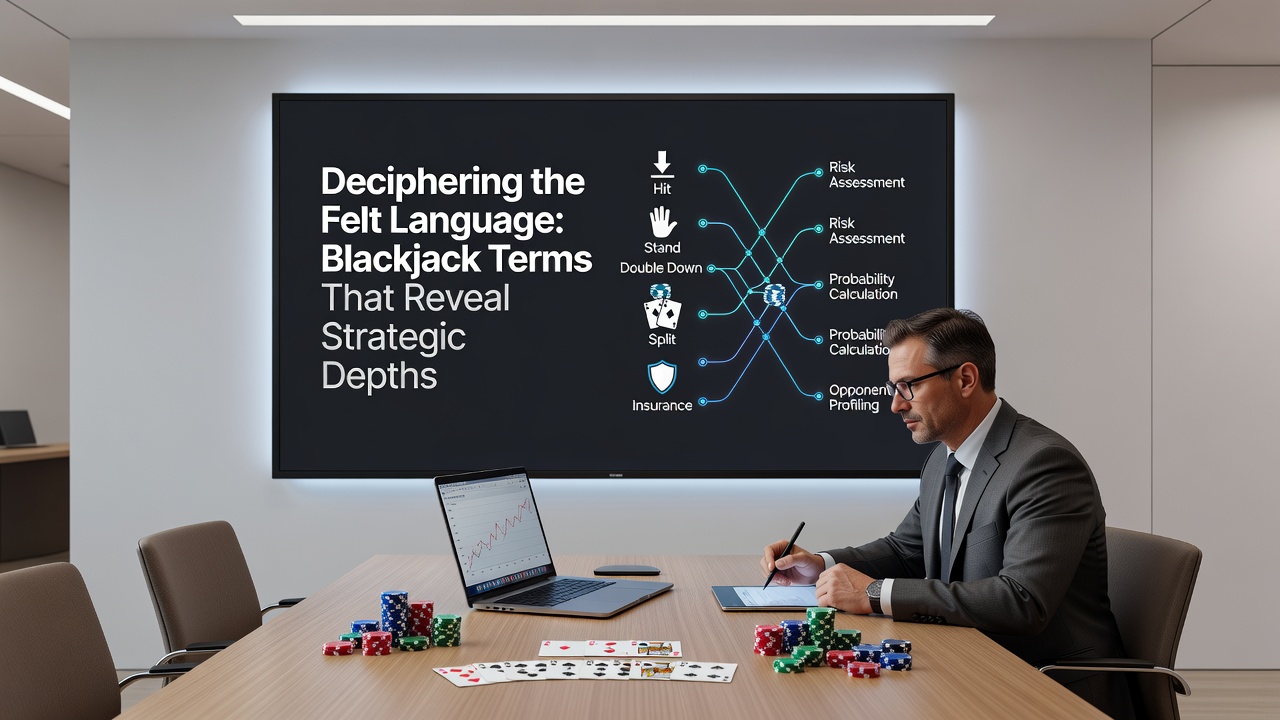
Terms such as hit and stand represent foundational choices yet they embed immediate probability assessments since hitting signals acceptance of additional card risk while standing locks in the current total against the dealer’s upcard, and observers note that mastering these distinctions forms the baseline for all subsequent strategy layers because data from regulated gaming environments shows consistent patterns in how these decisions correlate with long-term results.
Double down extends this framework by allowing players to increase their stake on favorable totals like nine through eleven, and the term itself signals recognition of situations where the expected value tilts positively enough to justify the added exposure, whereas splitting pairs creates separate hands that can transform marginal positions into stronger ones depending on the dealer’s visible card and the remaining deck composition.
Insurance, Surrender, and Risk Calibration
Insurance appears as a side bet when the dealer shows an ace yet it functions as a hedge against blackjack rather than a standalone wager, and players who understand its mathematical connection to the remaining tens in teh deck treat the term as a prompt for quick calculation instead of an automatic response, while surrender options, whether early or late, introduce an exit strategy that reduces losses on weak hands and thereby preserves bankroll for subsequent rounds where conditions improve.
Research indicates these protective terms gain relevance in multi-deck games common across North American and European casinos, and figures from the Nevada Gaming Control Board reveal how frequency of insurance and surrender usage tracks with overall player performance metrics when tracked over thousands of hands.
Card Counting Vocabulary and Deck Awareness
Card counting systems introduce their own lexicon including running count, true count, and penetration that translate raw card flow into actionable bet sizing adjustments, and the Hi-Lo system for instance assigns values to cards so that a positive true count prompts increased wagers because remaining cards favor the player, whereas negative counts signal restraint, and those who study these terms discover they reveal not just memory techniques but also the timing of when strategic aggression becomes mathematically sound.
Composition-dependent strategy further refines basic decisions by accounting for specific card combinations beyond simple totals, and experts have observed that players incorporating these nuances adjust plays such as soft doubling or certain pair splits based on the exact cards visible rather than totals alone, which adds precision in single-deck or double-deck formats still offered in select venues.
Regional and Rule-Specific Terminology
Rule variations carry their own shorthand such as DAS for double after split and RSA for resplit aces, and these abbreviations appear in game descriptions because they directly modify expected value calculations that influence whether basic strategy charts require adjustment, and data compiled by the Australian Gambling Research Centre shows measurable differences in player return rates when such rules are present versus absent across sampled casino floors.
Penetration refers to how deeply the dealer deals into the shoe before shuffling, and higher penetration improves counting effectiveness because more cards become known before the deck resets, while terms like heat describe increased scrutiny from casino staff when bet spreads widen in response to favorable counts, illustrating how the language bridges mathematical strategy with operational realities on the floor.
Conclusion
Blackjack terminology ultimately maps a decision tree where each word or phrase corresponds to a probability-weighted choice, and familiarity with this felt language enables players to interpret game conditions with greater accuracy across different rule sets and deck numbers, while ongoing analysis from regulatory bodies and research institutions continues to document how precise use of these terms aligns with measurable performance patterns in controlled environments as of June 2026.